The Hidden Cost of Manual Recruitment
Hiring one employee takes an average of 42 days and costs between ₹50,000 and ₹2,00,000 when you factor in recruiter time, job board fees, and the productivity gap during the vacancy. For companies hiring frequently, this operational load becomes a significant drag on the business.
The problem is not that hiring is hard. The problem is that most of the time spent is administrative — reading CVs, scheduling calls, sending follow-up emails, answering repetitive candidate questions. AI handles all of this better and faster than a human recruiter.
The Recruitment Funnel and Where AI Helps
Stage 1: Job Description Optimization
Before a single application comes in, AI can improve the quality of who applies. Job descriptions written with AI optimization tools:
This is often overlooked, but it is the highest-leverage starting point. Attracting better candidates makes every subsequent step easier.
Stage 2: CV Screening at Scale
For a typical open role, you might receive 200-500 CVs. A recruiter reading each one for 2 minutes would spend 7-17 hours on screening alone — for a single role.
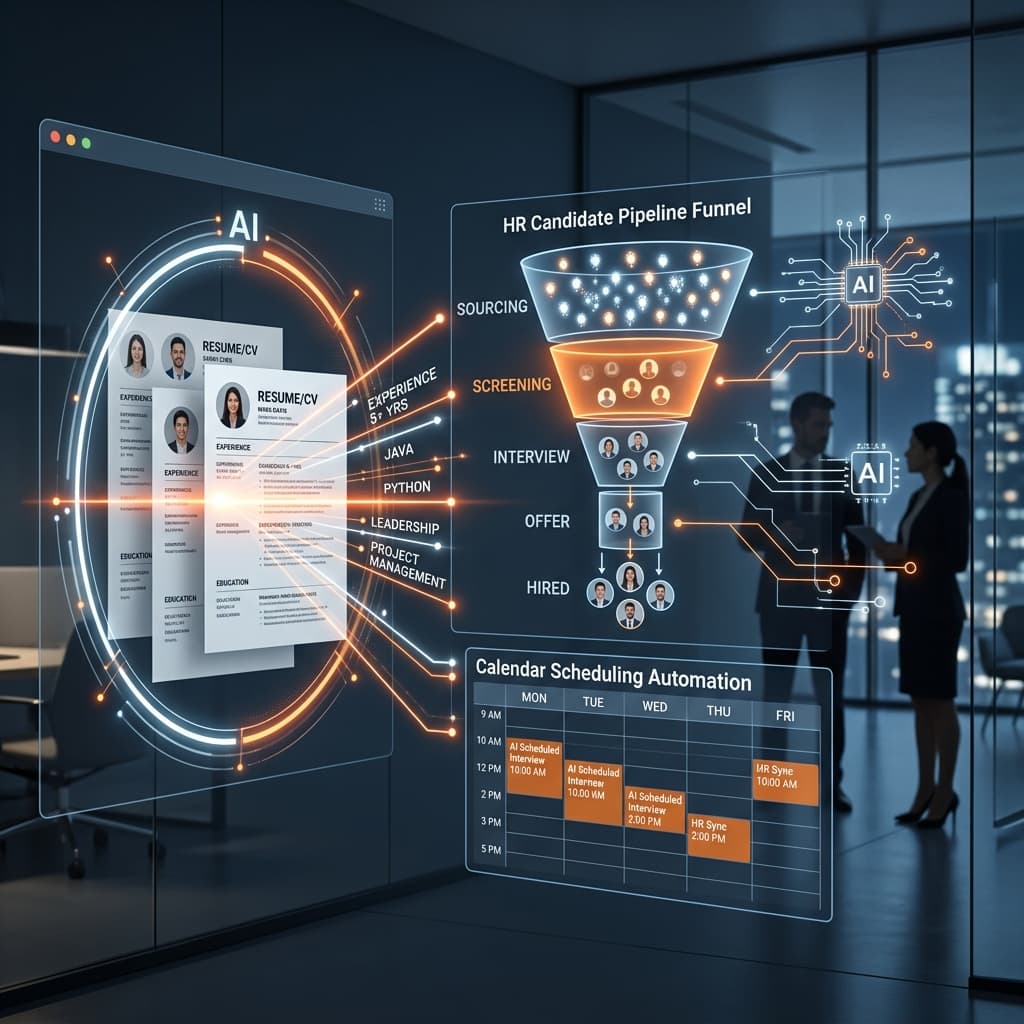
AI screening extracts key information from every CV (experience, skills, education, career trajectory) and scores each candidate against your role requirements. The top 10-15% get human attention. The rest receive automated, respectful rejection emails.
The time savings are immediate and substantial. A full screening round that used to take a week now takes hours.
Stage 3: Initial Candidate Communication
Qualified candidates drop out when communication is slow. An AI-powered communication system:
The speed advantage compounds: companies that engage candidates within 24 hours of application have significantly higher candidate acceptance rates at the offer stage.
Stage 4: Automated Interview Scheduling
Interview scheduling is one of the most tedious parts of recruitment. The back-and-forth of finding a time that works for the candidate, the hiring manager, and any panel members can take days.
An automated scheduling system sends a calendar link, the candidate picks a slot from real availability, and confirmations plus reminders go out automatically. What used to take 3-5 email exchanges now happens in one step.
Stage 5: Candidate Nurturing
Great candidates receive multiple offers. Keeping your candidates engaged throughout a multi-week process is critical — and easy to neglect when recruiters are busy.
Automated nurture sequences send:
This reduces candidate dropout during the pipeline significantly.
Stage 6: Offer and Onboarding Automation
Once an offer is made, automation handles the paperwork flow: offer letter generation, digital signing via DocuSign or similar, document collection, background check initiation, and first-day onboarding checklists.
New employees who receive structured onboarding are more likely to remain with the company long-term, and the cost of automating this process is a fraction of the cost of early attrition.
Results You Can Expect
| Metric | Manual Process | AI-Assisted Process |
|---|---|---|
| Time-to-hire | 35-50 days | 14-21 days |
| CVs screened per day | 30-50 | 500+ |
| Candidate response rate | 30-40% | 60-80% |
| Recruiter admin time | 60-70% of total | 20-30% of total |
Implementation Approach
We typically build HR automation in two phases. Phase one covers CV screening, automated communication, and interview scheduling — delivering the biggest immediate impact on recruiter productivity. Phase two adds the longer nurturing sequences, offer automation, and onboarding workflows.
The full system integrates with your existing ATS (Greenhouse, Lever, Naukri RMS, or a custom build) and your calendar systems.
Explore our workflow automation capabilities or schedule a discovery call to discuss your recruitment automation needs.