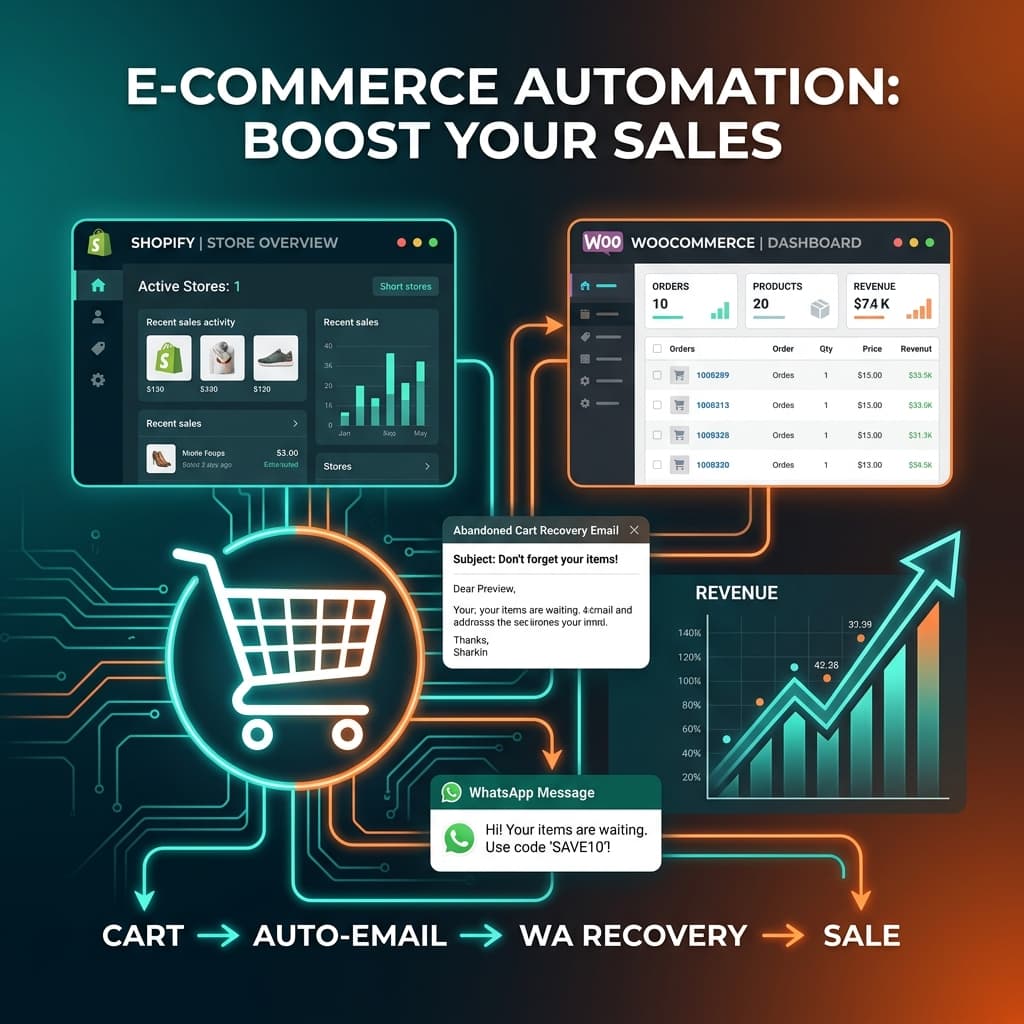
The Operational Bottleneck That Limits E-Commerce Growth
Growing an online store is not primarily a marketing problem — it is an operations problem. Most Shopify and WooCommerce store owners can get traffic and generate orders. What limits growth is everything that happens after the customer clicks Buy Now: support requests pile up, abandoned carts go unfollowed, inventory updates lag, and review requests never get sent.
These are exactly the problems that automation solves. Here is a complete breakdown of what to automate and in what order.
The Highest-Impact E-Commerce Automations
1. Abandoned Cart Recovery (The Biggest Win)
On average, 68% of online shopping carts are abandoned according to the Baymard Institute. Most stores send one generic email 24 hours later and give up. A properly sequenced recovery automation works much harder:
The multi-channel approach (WhatsApp + email) significantly outperforms email alone, particularly for Indian customers who are more responsive on WhatsApp.
2. Customer Support Automation
The top three questions every e-commerce store receives account for 60-70% of all support volume:
Automating answers to these three questions alone cuts support volume in half. An AI support system connects to your order management system, pulling real-time tracking data and providing accurate order status without human intervention.
For Shopify stores, this connects to your Shopify admin. For WooCommerce, it connects via your order database. The result: support tickets that require a human agent are genuinely complex ones, not routine status checks.
3. Review Request Sequences
Positive reviews drive conversion rates. More reviews mean better product rankings, higher buyer trust, and better SEO. But most stores either never ask for reviews or send a single email that most customers ignore.
An automated review request flow:
4. Inventory and Restock Alerts
Running out of a popular product is costly — you lose the sale and potentially the customer. Automated inventory management:
5. Post-Purchase Upsell Sequences
The best time to sell to a customer is right after they have bought. An automated post-purchase sequence recommends complementary products based on what they purchased, using personalization that general broadcast emails cannot match.
| Day | Message | Channel |
|---|---|---|
| Day 1 | Order confirmation + usage tips | |
| Day 7 | How-to content for purchased product | |
| Day 14 | Complementary product recommendations | |
| Day 30 | Loyalty discount or referral offer | WhatsApp + Email |
Tools That Work Well for E-Commerce Automation
For Shopify stores, the native automation tools are decent but limited. Combining Shopify Flow with Klaviyo for email and a WhatsApp integration (WATI or AiSensy) handles most automation needs without custom development.
For WooCommerce, the ecosystem is more fragmented but also more flexible. AutomateWoo handles on-site triggers well, and connecting it to an n8n instance for complex multi-channel workflows gives you enterprise-level automation at a fraction of the cost.
For stores processing above ₹50 lakh per month, custom-built automation systems — integrating your store, CRM, payment system, and logistics provider — typically deliver better results than piecing together SaaS tools.
Starting Point Recommendation
If you are just starting with automation, begin with abandoned cart recovery. It generates immediate, measurable revenue from leads you are already getting. Use the ROI from that to fund more comprehensive automation.
Use our ROI calculator to estimate your potential recovery revenue, or talk to our team about an e-commerce automation strategy for your store.