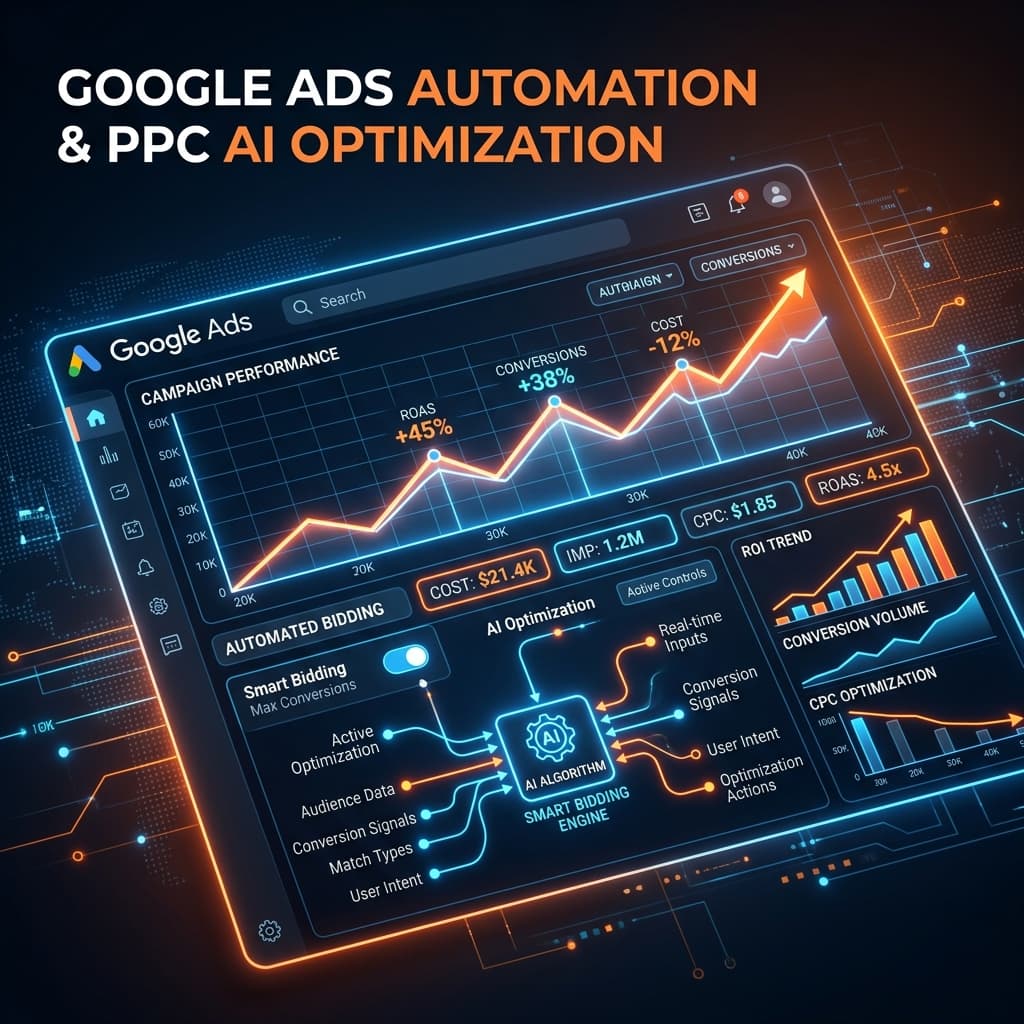
Why Manual Google Ads Management Falls Behind
Google Ads auctions happen billions of times per day. Each auction considers dozens of signals in real time — the searcher's location, device, time of day, search history, the competitiveness of the keyword, and the quality of the available ads. No human campaign manager can process and respond to these signals at the speed and scale required.
This is why AI-powered campaign management has become the standard for serious advertisers, not an optional upgrade. Here is what that looks like in practice.
The Automation Layers in Modern Google Ads
Smart Bidding: The Foundation
Google's own Smart Bidding algorithms (Target CPA, Target ROAS, Maximize Conversions) use machine learning to set bids on every auction based on real-time signals. Manual bidding — setting a single bid for a keyword and adjusting weekly — cannot compete with this level of optimization.
But Smart Bidding is only as good as the conversion data you feed it. The most common mistake we see: businesses running Smart Bidding without enough conversion volume, giving the algorithm insufficient data to optimize effectively. Smart Bidding needs at least 30-50 conversions per month per campaign to work properly.
Responsive Search Ads: Dynamic Creative Testing
Traditional ad A/B testing involves creating 2-4 ad variations and waiting weeks for statistically significant results. Responsive Search Ads (RSAs) take a different approach: you provide up to 15 headlines and 4 descriptions, and Google's algorithm learns which combinations perform best for different searchers.
Over time, the algorithm discovers the combinations that work and shows them more frequently. This compresses months of manual testing into a few weeks of machine learning.
The key is feeding the algorithm high-quality, varied inputs. We see many accounts where all 15 headlines are essentially the same message rephrased. The algorithm cannot do much with that.
Automated Asset Testing
Beyond headlines and descriptions, Performance Max campaigns can automatically test:
The campaign learns which combinations of assets, audiences, and placements drive the most value, then allocates budget accordingly.
Custom Scripts for Advanced Automation
Google Ads Scripts let you automate management tasks that Google's native automation does not handle:
Scripts run on a schedule and interact directly with your account. A library of proven scripts can handle most routine optimization tasks.
AI-Powered Campaign Intelligence
Beyond the in-platform automation, third-party AI tools add another layer:
Predictive budget allocation: Analyzes historical performance patterns and upcoming competitive dynamics to recommend how to distribute budget across campaigns.
Search term intelligence: Identifies new converting search queries you should target and damaging terms you should exclude, much faster than manual review.
Competitive benchmarking: Tracks competitor ad positions, messaging, and landing page strategies to inform your own positioning.
Automated reporting: Pulls performance data across campaigns, channels, and time periods into formatted dashboards that update automatically.
Common Mistakes to Avoid
The most expensive Google Ads mistakes we see:
Setting overly restrictive ROAS targets too early before the algorithm has learned. Underspending so the algorithm never gets enough data to optimize. Running too many campaigns at low volume instead of consolidating. Not using conversion value information that allows the algorithm to optimize for revenue rather than just leads.
Getting Your Campaigns to Work Properly
A properly structured, AI-managed Google Ads account for a small-to-medium business typically delivers:
| Metric | Before AI Optimization | After 90 Days |
|---|---|---|
| Cost per lead | High, variable | 25-40% lower |
| Conversion rate | Baseline | 15-30% higher |
| Wasted spend (irrelevant clicks) | 20-40% of budget | Under 10% |
| Optimization time required | 8-12 hours/week | 2-3 hours/week |
See our AI marketing capabilities for full details, or book a free audit of your existing campaigns.